
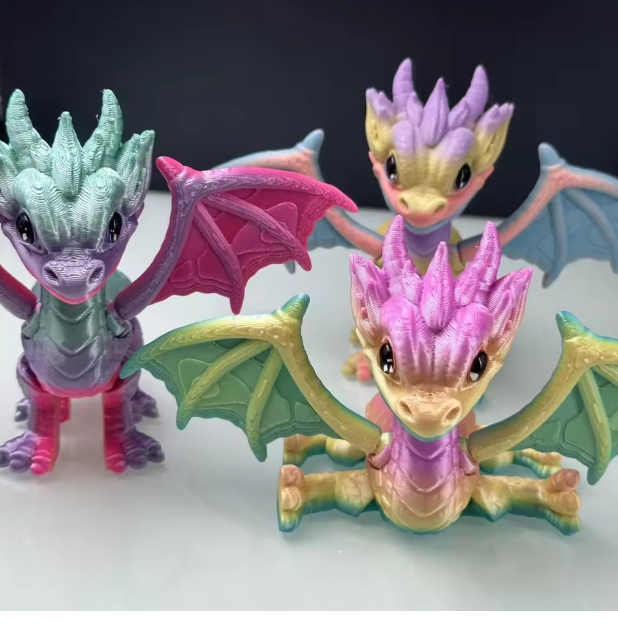
3D Printing Revolutionizes Toys: Reshaping the Boundaries and Future of Traditional Toys
When children hold their self-designed 3D-printed dinosaur models for the first time, and when every edge of a fidget spinner precisely replicates the creative idea in their minds, a silent revolution in the world of toys is underway. 3D printing technology is irreversibly redefining the meaning of “toys” and bringing disruptive changes to the traditional toy industry.
I. The Wave of Personalization: From “One Size Fits All” to “A World for Each Individual”
The assembly-line production model of traditional toys inevitably leads to standardization and homogenization. 3D printing technology completely breaks this constraint:
Design sovereignty returns: Children are no longer passive recipients, but creators. Through simple modeling software, they can transform their wild imaginations into physical objects – from alien creatures to robotic pets, from fairy tale castles to scientific instruments.
Precise customization experience: Parents can adjust the size, color, and even joint mobility of toys according to their children’s height and preferences. For example, printing building blocks that are more comfortable to hold for children with special needs, or using PLA+ environmentally friendly resin materials for children with allergies.
II. Upgraded Educational Value: Toys Become “Three-Dimensional Textbooks”
The educational function of traditional toys mostly stays at the cognitive level, while 3D printed toys achieve deep practical learning through “learning by doing”:
STEM education carrier: Printing gear transmission models to understand mechanical principles, designing bridge structures to test load-bearing capacity, and creating cell models to observe the microscopic world.
Interdisciplinary integration: Art students can print sculpture prototypes, history enthusiasts can reproduce artifacts, and programming enthusiasts can combine 3D printing to create robots.
III. Green Manufacturing Revolution: Environmental Protection Starts at the Source
The “disposable consumption” model of traditional plastic toys is being rewritten by 3D printing:
On-demand production, zero inventory waste: Small-batch customization avoids large-scale stockpiling, reducing over 2 million tons of inventory loss in the global toy industry every year.
Material innovation: Using corn-based PLA and PETG biodegradable materials, old toys can even be recycled and reprinted, forming a closed-loop ecosystem.
IV. Production Model Restructuring: New Soil for Niche Cultures
3D printing is giving rise to niche markets that traditional toys cannot cover:
Niche IP incubation: Independent designers publish models through platforms, and fans pay to download and print them, breaking the monopoly of large manufacturers. Collectible Miniature Art: High-precision models of mechanical devices and anime figures at a 1:100 scale are becoming a new favorite among collectors.
V. Challenges and the Future: Towards Symbiosis Through Collaboration
3D printed toys are not without their flaws:
Current bottlenecks: Limited precision of home printers (>0.1mm), high cost of industrial-grade equipment; time-consuming post-processing of complex structures.
The counterattack of traditional toys: Lego introduces a hybrid model of “digital design + physical bricks,” and Barbie dolls incorporate AR for enhanced interactive experiences.
Conclusion: The Symphony of Two Toy Types
3D printed toys are not meant to replace traditional toys, but rather to complement them, like the perfect combination of Lego and building blocks – the former offering unlimited creative possibilities, and the latter preserving the classic interactive experience. When children use 3D printed gears to drive a traditional rocking horse, and when vintage toys are digitally reborn through scanning, we see not only technological progress but also the ever-expanding boundaries of human creativity.